Development costs12 min read
Custom Web Application Development Cost in the UK
Custom Web Application Development Cost in the UK: Price Ranges by Complexity and How to Check a Quote
By Duncan
Key takeaways
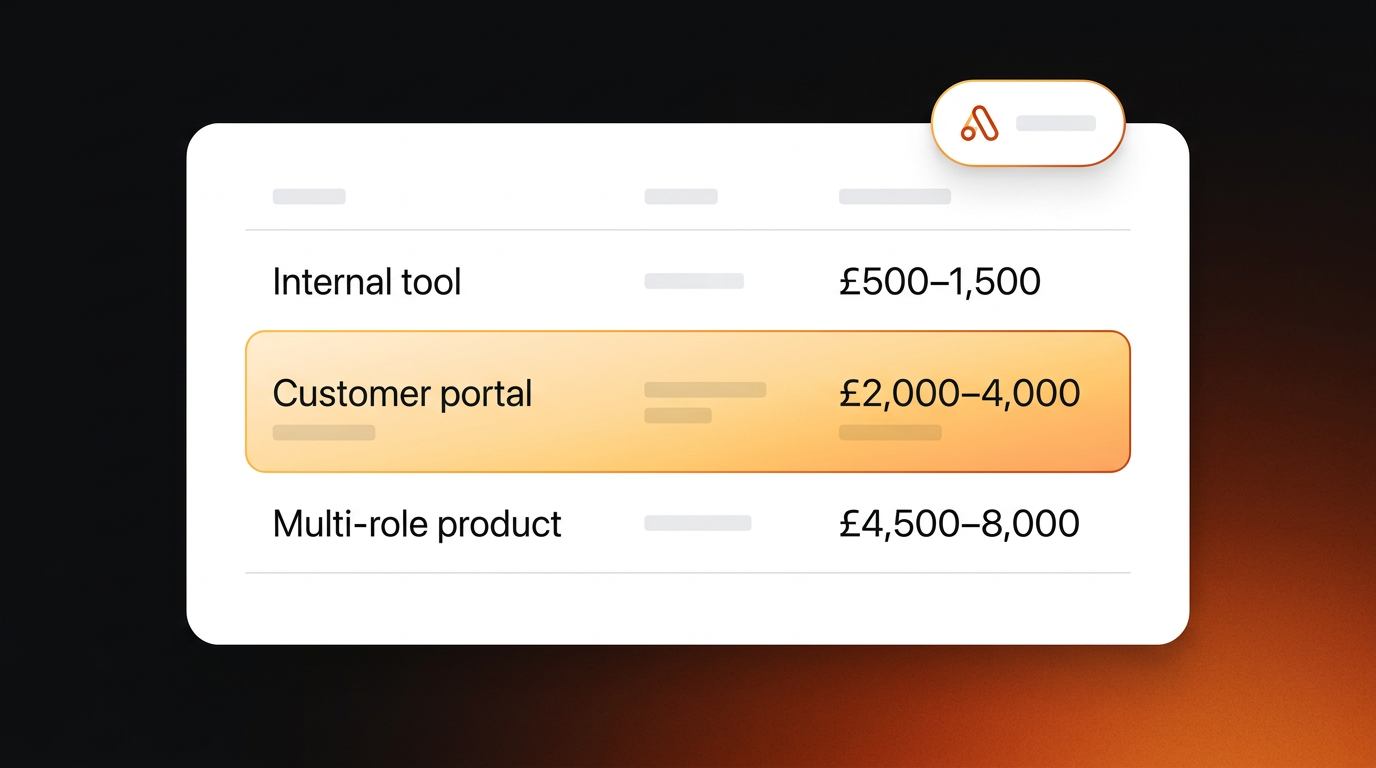
A simple internal tool that replaces a spreadsheet typically costs £10,000 to £30,000 and takes six to ten weeks.
A customer portal with a few roles and integrations typically costs £30,000 to £90,000.
A multi-role SaaS-style product typically costs £90,000 to £250,000 or more.
Integrations, permissions and data model complexity move the price more than the number of screens.
Budget 15% to 25% of the build cost each year to run and maintain the application.
Custom web application development cost in the UK usually runs from about £10,000 for a simple internal tool to £90,000 or more for a multi-role, SaaS-style product. A customer portal with a handful of roles and integrations sits between the two, at roughly £30,000 to £90,000. The final figure depends more on integrations, permissions, data complexity, design polish and compliance than on the number of screens.
If you are holding two or three quotes that look nothing alike, this guide should help you compare them. We set out ranges by tier, show how each cost driver moves the price, compare agency, freelancer and in-house costs, and explain what a fixed price does and does not cover.
Custom web application cost in the UK
A custom web application costs between £10,000 and £250,000 or more in the UK, and the tier of complexity explains most of that spread. These are the ranges we see and use when scoping work. They are guides, not quotes, and your own scope can sit outside them.
| Tier | Typical scope | Typical price | Typical timeline |
|---|---|---|---|
| Simple internal tool | One core workflow, one or two roles, standard interface, few or no integrations | £10,000 to £30,000 | 6 to 10 weeks |
| Customer portal | A handful of roles, login, a few integrations, a designed interface, reporting | £30,000 to £90,000 | 3 to 5 months |
| Multi-role SaaS-style product | Many roles and permissions, several integrations, billing, admin tooling, compliance | £90,000 to £250,000+ | 6 to 12 months or more |
Most of the international figures you will find online are in dollars, from US or offshore teams, and they group the tiers differently. Use them as a rough cross-check only. UK day rates, VAT and the cost of supporting software in UK business hours all change the sums.
Tier one: a simple internal tool
A simple internal tool replaces a spreadsheet or a pile of manual steps with one proper workflow. Think job tracking, stock levels, quote approvals or a staff request system. It has a small number of users, one or two roles, and a standard interface with no bespoke design work.
This is the tier where custom software is most often worth it for a small business. The scope is small enough to build in six to ten weeks, and the cost is a fraction of an enterprise project.
Tier two: a customer portal
A customer portal lets your customers log in to see orders, documents, invoices, bookings or progress. It typically has a handful of roles, such as customer, customer admin, staff and manager. It connects to at least one other system, often a CRM, accounting package or payment provider.
The price rises here because mistakes are public. A permissions bug in an internal tool is an annoyance. In a customer portal it can show one customer another's data. That needs more design care and more testing, and both cost money.
Tier three: a multi-role SaaS-style product
A multi-role product is software you may sell or run for many organisations. It has several user types, fine-grained permissions, billing, admin tooling, audit trails and often multiple tenants. It usually has several integrations and some compliance work.
At £90,000 to £250,000 or more, this is a different category of project from the first two. Most small businesses asking about custom software do not need it. If you do, expect the build to run in phases, with a first release that covers the core and later releases that extend it.
What drives the cost of a custom web application
Five things move the price most: integrations, authentication and permissions, data model complexity, interface polish and compliance. The number of screens matters much less than people expect, because a screen is quick to build once the rules behind it are settled.
Integrations
Every integration adds work in building, testing and keeping it running. A well-documented API from a mainstream provider might add a few days. A system with a poor API, limited documentation or unpredictable behaviour can add weeks. Integrations also break when the other side changes, so they cost money to maintain after launch.
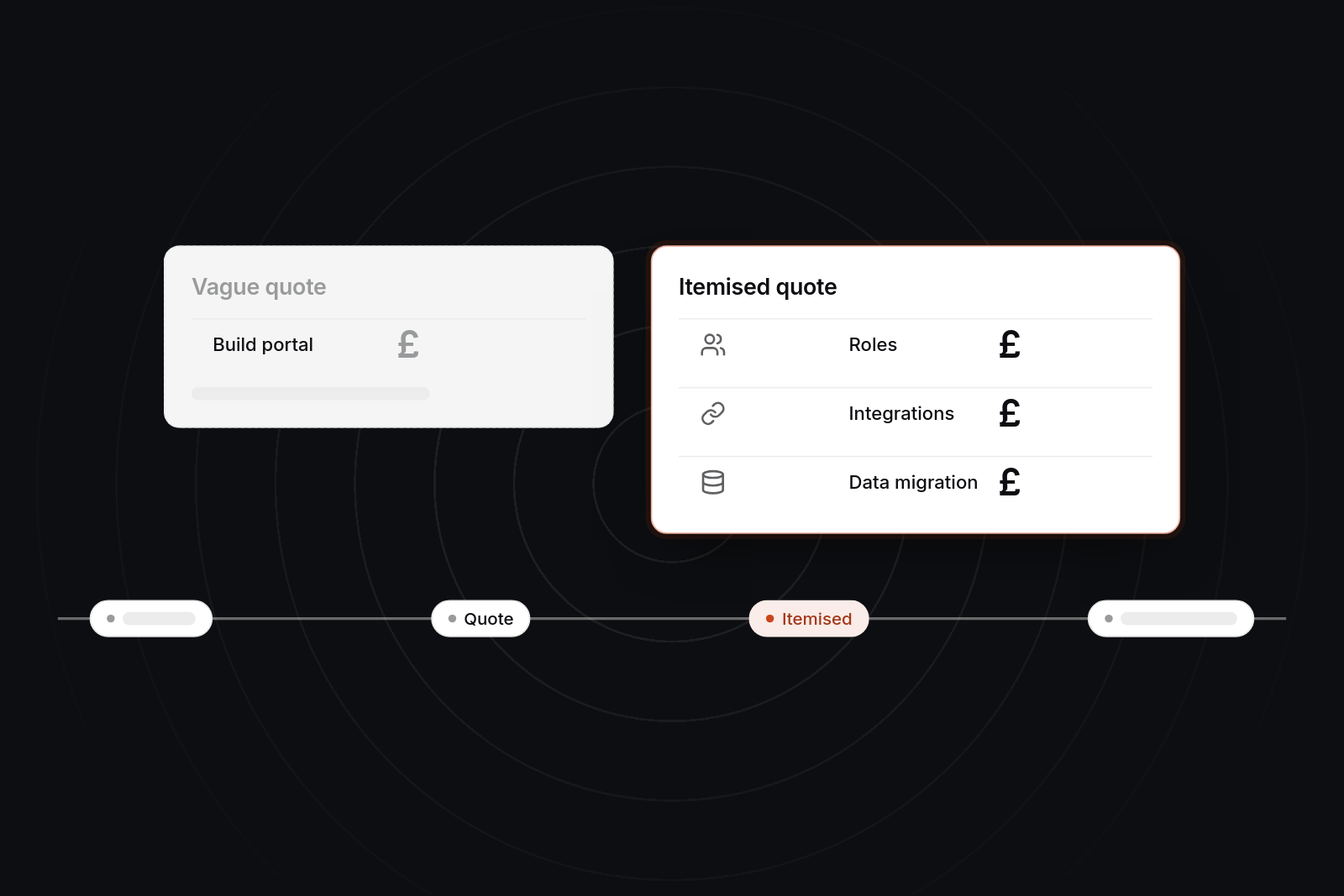
When comparing quotes, ask how many integrations each one assumes and which systems they connect to. Two quotes can differ by £15,000 purely because one assumed a simple accounting sync and the other assumed a two-way one.
Authentication and permissions
Login is quick to add. Deciding who can see and change what is where the time goes. One role with a simple login is cheap. Five roles, where some users see only their own records, others see a team's, and managers approve changes, need careful design and thorough testing.
Single sign-on, two-factor authentication and invitation flows each add to the total. Ask any vendor to list the roles they have priced for. If there is no list, the quote is a guess.
Data model complexity
The data model is how the application stores and relates information: customers, orders, jobs, documents and the links between them. A simple model has a few tables and clear relationships. A complex one has history, versions, approvals, many-to-many links and rules that change over time.
Buyers see this driver least, and it often explains the biggest gaps between quotes. Migrating existing data from spreadsheets or an old system belongs here too. Messy source data can take longer to clean than the new application takes to build.
Interface polish
A standard, clean interface built from proven components is cheaper than a fully bespoke design with custom animations and many unique layouts. For internal tools, standard is usually the right call. For a customer portal, a designed interface is worth paying for because it shapes how your customers see you.
Design is also a place to save without much risk. Start with a clear, plain interface and add polish after launch, once you know which screens people use most.
Compliance
Handling personal data brings UK GDPR obligations. Payments, health data or regulated financial work bring more. Compliance adds cost through extra security work, audit logging, data retention rules, documentation and sometimes outside review. Tell every vendor up front what you handle. A quote that ignores compliance is incomplete rather than cheap.
How the drivers move the price
| Cost driver | Lower-cost version | Higher-cost version | Effect on a quote |
|---|---|---|---|
| Integrations | None, or one simple one | Several, including two-way syncs | Can add weeks and £5,000 to £30,000 or more |
| Permissions | One or two roles | Many roles with record-level rules | Moves a project up a tier |
| Data model | A few related tables | Histories, approvals, migration from old systems | Often the largest hidden difference |
| Interface | Standard components | Bespoke design across many screens | Adds design and build time |
| Compliance | Basic data protection | Payments, regulated data, audit trails | Adds security and documentation work |
Agency, freelancer and in-house costs compared
An agency usually costs the most per hour but covers the widest range of skills. A freelancer costs less but you depend on one person. An in-house hire is the most expensive way to start but the cheapest way to keep changing software over many years. Each has costs that do not appear on the first invoice.
| Option | Typical cost shape | Hidden costs | Best fit |
|---|---|---|---|
| Large agency | Highest day rates, heavy process, often open-ended retainers | Project management overhead, changes charged at full rate, retainers with no ceiling | Large, complex projects with several teams |
| Freelancer | Lower day rate, often one person doing everything | No cover if they are ill or busy, one person's judgement, handover problems later | Small, well-defined work with a trusted person |
| In-house hire | Salary, employer costs, equipment and recruitment, whether or not there is work | Months to hire, one person's knowledge, cost of cover and management | Steady, ongoing development across years |
| AppBespoke | Fixed-scope quotes agreed before work starts, with full code ownership handed over | Does not do open-ended retainers with no ceiling, does not build large enterprise systems as a starting point, and does not maintain code it has not reviewed | Businesses that want a lean build that stays cheap to change |
Agencies
Agencies bring design, development, testing and project management under one roof, and the price reflects that. Watch how change requests are priced and whether support after launch has a ceiling. Open-ended retainers can run well past a sensible maintenance budget if nobody is watching the hours. If you are deciding between models, our post on hiring a dev agency instead of an in-house team goes deeper.
Freelancers
A good freelancer can be excellent value for a small, clear piece of work. The risk is that everything depends on one person. If they are unavailable, or move on, you may be left with code only they understand. Ask who owns the repository and the hosting accounts from day one.
In-house developers
A salaried developer is a long-term commitment. You pay for them between projects, and you carry the cost of hiring, managing and covering absence. It works well once there is enough steady work to keep them busy. For a first project, it is rarely the cheapest route.
Low-code and off-the-shelf tools
These belong in your comparison. Off-the-shelf software is faster to start and cheaper at small scale, and for standard tasks such as accounting or basic CRM it is usually the right answer. Custom earns its place when your workflow does not fit any product without constant workarounds, or when per-user pricing climbs faster than the value you get. See custom software vs off-the-shelf SaaS on long-term cost for a fuller comparison.
How to sanity-check a quote
Compare what each quote assumes, not the headline figure. Two quotes for the same project can differ by tens of thousands of pounds because they assumed different scopes.
Ask each vendor to confirm these points:
- The number of user roles priced, and what each one can do.
- Which integrations are included, and whether they are one-way or two-way.
- Whether existing data is being migrated, and who cleans it.
- Whether the design uses standard components or is bespoke.
- What compliance work is included.
- Who owns the code, the repository and the hosting accounts at the end.
- What a year of support costs, and what it covers.
A quote that cannot answer these in writing is not ready to be compared. A quote that answers all of them clearly is usually the better guide to what you will actually pay, even if its headline number is higher. For more on shortlisting vendors, read how to choose a custom web app development company.
What a fixed price covers and what it does not
A fixed price covers the scope written into the agreement and nothing outside it. You know the cost of what you agreed, but anything new is a change.
A fixed price typically covers:
- The features, roles and integrations listed in the scope document.
- Design, build, testing and deployment of that scope.
- Handover of the code and documentation.
It does not usually cover:
- Features added after the scope is agreed.
- Third-party costs such as hosting, licences and API fees.
- Data migration beyond what was agreed.
- Ongoing maintenance after launch.
A fixed scope does not guarantee against surprises. If the scope is vague, the price will change when the vague parts get defined. The protection comes from a specific scope, written down before work begins. An open-ended hourly arrangement can also be reasonable, as long as you know which one you are agreeing to and what the ceiling is.
What it costs to run after launch
Budget 15% to 25% of the build cost each year to keep a custom web application running. That covers hosting, security patches, dependency updates, bug fixes and a set amount of small feature work. It does not usually cover a major redesign or a significant new module. Our breakdown of the cost to maintain a custom web application per year shows where that money goes.
For a £30,000 build, that is roughly £4,500 to £7,500 a year. The first year can run higher, closer to 20% to 30%, because real users find things testing missed. Leave this out of your comparison and custom software will look cheaper than it is against a subscription tool.
Custom web application examples
Common custom web application examples include job tracking systems, quote and approval tools, stock and order management, customer portals, booking systems and reporting dashboards that pull from several sources. Most replace a spreadsheet or join together systems that do not talk to each other.
Smaller examples fall in the first tier. A tool that lets a team log jobs, assign them and report on progress is typically a £10,000 to £30,000 project. A portal where customers log in to see orders, download documents and raise requests is typically second tier. A product sold to many organisations, each with its own users and data, is third tier.
Next step
If you are weighing quotes or scoping a first build, book a 30-minute video call with us. We will go through what you have and tell you plainly whether custom software fits. If it does, the next step is our £750 technical planning day, which turns your idea into a written scope you can price against any other quote.
FAQs
How much does it cost to build a custom web application?
In the UK, expect roughly £10,000 to £30,000 for a simple internal tool, £30,000 to £90,000 for a customer portal with several roles and integrations, and £90,000 to £250,000 or more for a multi-role SaaS-style product. Add 15% to 25% of the build cost each year to run it.
How much does it cost to develop a custom website?
A custom website that is mostly content costs much less than a custom web application, because it has little application logic. Once a site has user accounts, stored data and rules that change what each user sees, it becomes a web application and the ranges in this post apply. The line between the two is whether the software acts on data, not how the pages look.
How much does custom software development cost in 2026?
The ranges in this post reflect how we price work now. Day rates and tooling change, so treat any figure as a starting point and ask for a written scope. Price moves mainly with integrations, permissions and data complexity, and those matter more than the year.
Is it expensive to build your own app?
It depends on what you build. A single internal tool solving one problem is within reach for many small businesses at £10,000 to £30,000. The expensive projects have many roles, many integrations and compliance requirements. Starting with one workflow and extending it later keeps the first bill manageable.
How much do website updates cost?
For a custom application, small updates are usually covered by the annual maintenance budget of 15% to 25% of build cost, which includes a set amount of small feature work. Larger changes, such as a new module, are normally scoped and priced separately.