Key takeaways
Assistants cite pages that give clear, specific answers: who you serve, what it costs, how long it takes and who it is not for.
Your site needs to be crawlable, quick to load and consistent with third-party sources such as directories, reviews and press.
Start with the questions buyers ask just before they shortlist, then add comparison and FAQ content.
Measure by running a fixed set of prompts on a schedule, checking referral traffic and noting which pages get cited.
Results are not guaranteed and outputs vary between runs.
To get my business recommended by ChatGPT, or yours, publish pages that say plainly who you serve, what you charge, how long the work takes and where you are a poor fit. Put them on a fast site that crawlers can read, and keep what other sources say about you consistent with those pages. There is no trick and no paid placement. The work is mostly good content and technical hygiene.
We are a Glasgow-based team that builds web applications, and we have been looking at how buyers now ask AI assistants for supplier recommendations. This post covers what assistants tend to cite, how to structure pages, which questions to answer first, how to measure results and what an AI search audit covers.
What AI assistants tend to cite and why
Assistants tend to cite pages that answer the question directly, with specific facts, on sites they can read, and that match what other sources say. When an assistant searches the web to answer a buying question, it needs text it can quote and trust. Vague marketing copy gives it nothing.
Four things show up repeatedly in the pages that get cited.
Plain statements of who you serve
A page that says "we build customer portals for UK logistics firms with 20 to 200 staff" is easy to match to a buyer's question. A page that says "we deliver transformative solutions" is not. The assistant can only decide which supplier fits from what is written down.
Specific prices and timelines
Buyers ask what something costs and how long it takes. Pages that give a range, even a wide one, answer that. Pages that say "contact us for a quote" leave the assistant to fill the gap from elsewhere, or to name a competitor who did publish figures.
Honest limits
A page that says where you are a poor fit is more believable, and it gives the assistant a reason to recommend you for the right job. It also stops you being recommended for work you would turn down.
Agreement with other sources
Assistants read more than your site. They also read directories, review sites, press mentions and your profiles elsewhere. If your site says one thing and a directory listing says another, the answer becomes less certain. Consistent names, descriptions, locations and service lists across sources make you easier to describe.
OpenAI documents that its search feature draws on web results and that a site needs to allow its search crawler to be eligible. Other assistants have their own crawlers and sources. Check each vendor's current documentation, because these details change.
How to structure pages so they can be cited
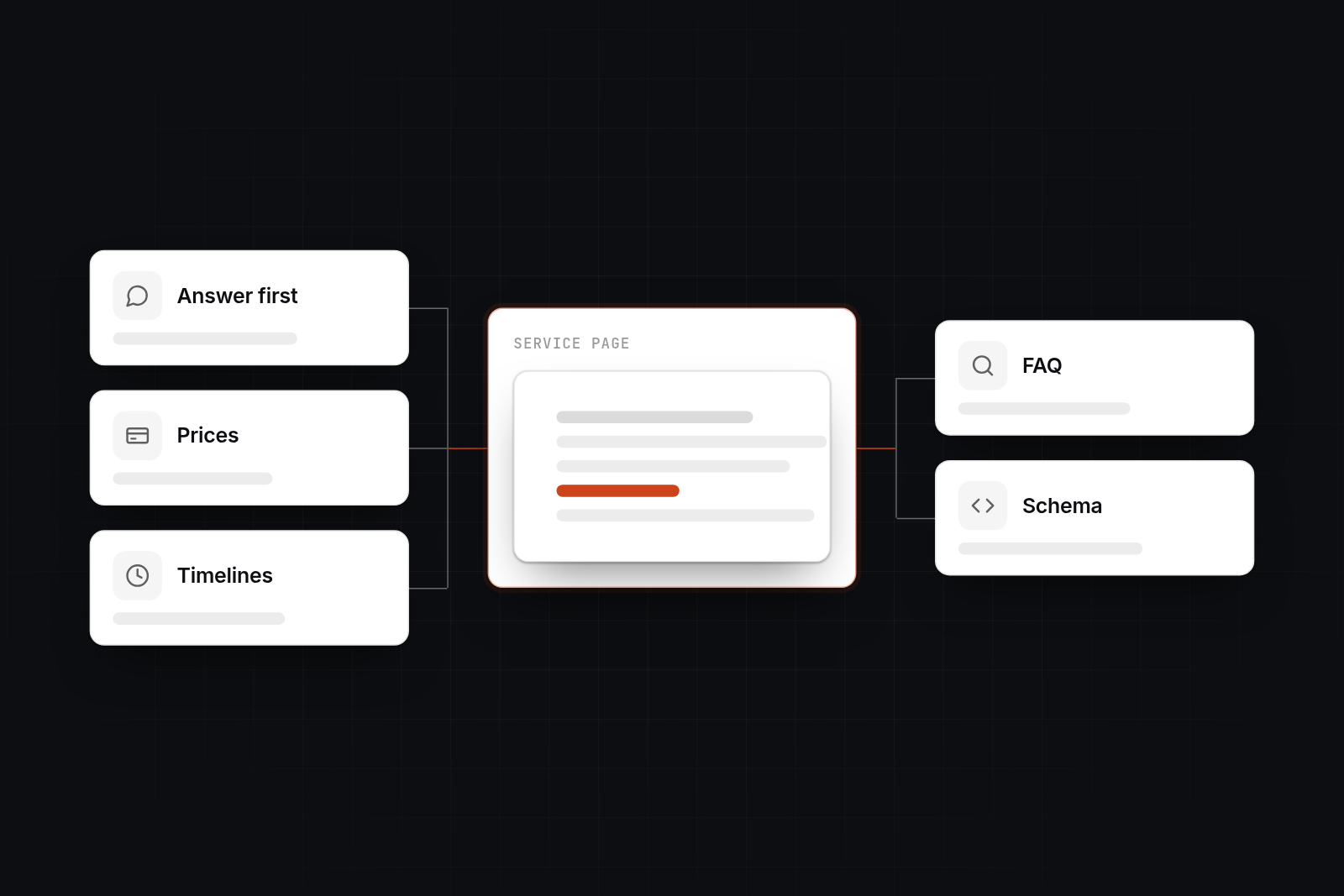
Put the answer first, make the facts specific, and use headings that tell a reader, or a crawler, what each section covers. The layout that helps a busy buyer helps an assistant too.
Put the plain answer up front
Open with two or three sentences that answer the page's main question and make sense if quoted alone. For a service page, that means what you do, who it is for, roughly what it costs and how long it takes. Detail follows below.
Use specific figures
Give price ranges and timelines for typical projects, and say they are examples rather than quotes. If you need help working out realistic numbers, our guide to custom web application development cost in the UK is a useful reference. A table works well here:
| Project | Example fixed price | Typical timeline |
|---|---|---|
| Small internal tool | £5,000 to £15,000 | 4 to 8 weeks |
| Customer portal | £15,000 to £40,000 | 8 to 16 weeks |
Use your own real figures. Do not copy these.
Add comparison content
Buyers ask assistants to compare options: agency or freelancer, custom or off-the-shelf, one supplier against another. A page that compares options honestly, including where you lose, gives an assistant material it can use. Include yourself in the table and say what you do and do not do. Our posts on custom software versus off-the-shelf SaaS and hiring a dev agency instead of an in-house team show the format.
Add FAQ content
Write questions as buyers phrase them and answer each in a short paragraph. Keep each answer self-contained, so it makes sense when quoted without the rest of the page.
Keep headings and markup clean
Use one H1, then H2 and H3 headings that describe the section. Add structured data (schema) where it fits: Organization for your company details, FAQPage for question and answer sections, and Service or Product for what you sell. Schema does not guarantee a citation. It removes ambiguity about what a page contains.
Make the site fast and readable without scripts
Important text should be in the HTML the server returns, not built in the browser after load. Some crawlers do not run scripts. Check that key pages load quickly, are not behind a login and are not blocked in robots.txt for the crawlers you want. This is ordinary technical hygiene, and it is where a custom build either helps or gets in the way.
Which buyer questions to answer first
Start with the questions buyers ask just before they shortlist a supplier: what does it cost, how long does it take, who is it for and how do you compare. These carry the most buying intent, and assistants are asked them most.
A practical order:
- Who you serve: One clear statement on the home page and each service page.
- What it costs: Ranges for your usual projects, with what is and is not included.
- How long it takes: Typical timelines by project type.
- Who you are not for: The jobs you decline or refer elsewhere.
- How you compare with the alternatives: Agency against freelancer, custom against off-the-shelf, and so on.
- What happens after launch: Support, running costs and who owns what.
To find the exact wording, use the questions your sales team hears, the search terms in your analytics and the prompts you run yourself. Write the page title and first paragraph in the buyer's words, not yours.
How to measure whether it is working
Run a fixed set of prompts on a regular schedule, check referral traffic from AI assistants and note which of your pages get cited. One-off checks mislead, because answers change from run to run.
Track a fixed prompt set
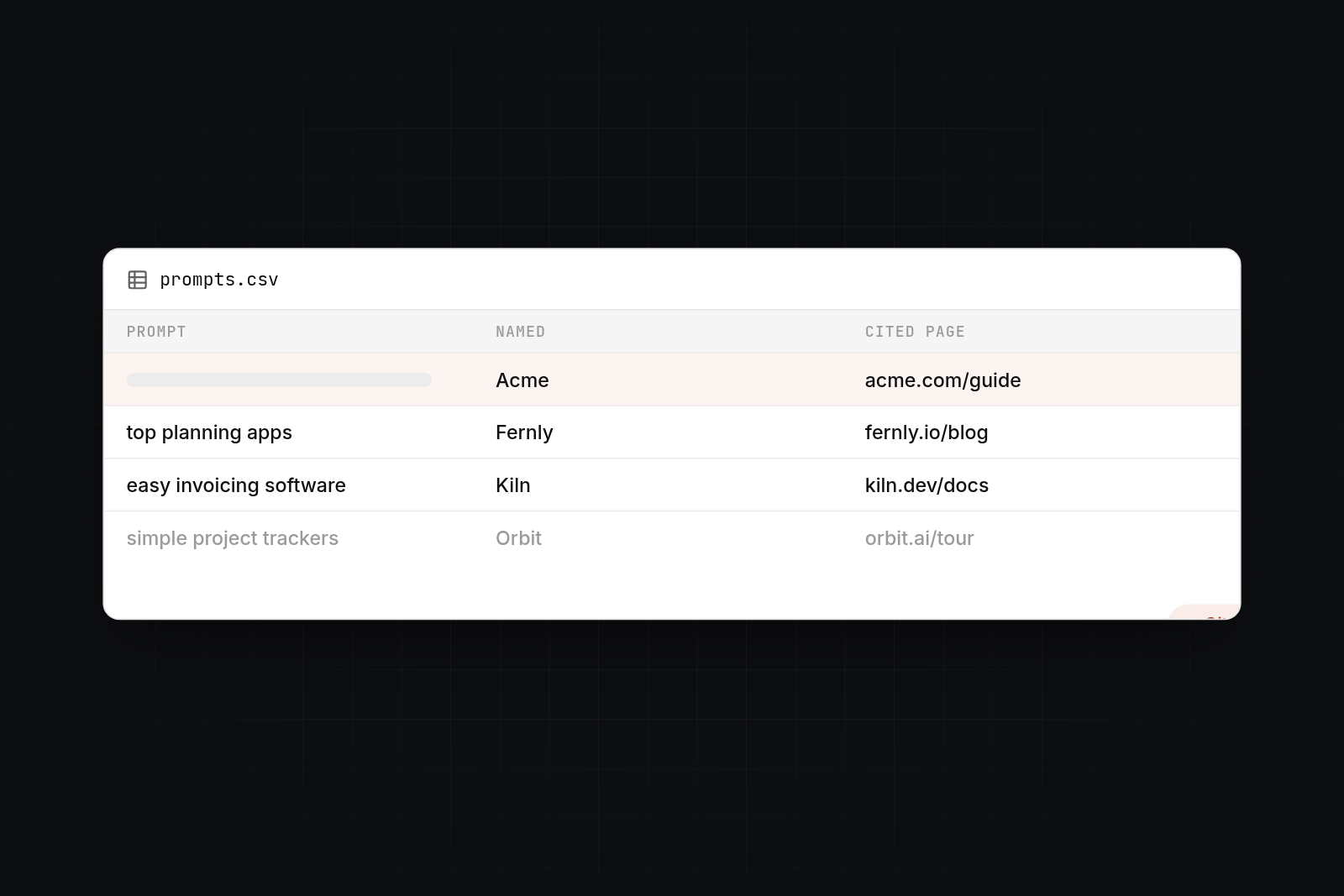
Write 15 to 30 prompts that match how your buyers ask. Include category questions ("who offers X in the UK"), problem questions ("how do I solve Y") and comparison questions. Run the same set monthly across the main assistants, and record whether you are named, whether you are recommended, which sources are cited and which competitors appear. Keep the exact wording stable so you can compare month to month.
Run each prompt more than once. Outputs vary between runs, so a single appearance or absence tells you little. Look at how often you appear across several runs.
Check referral traffic
In your analytics, look for visits from assistant domains and for landing pages that match cited content. Traffic from assistants is usually small and may be partly hidden, because not every click carries a referrer. Treat it as one signal among several.
Note which pages get cited
When an assistant cites you, record the page. Over time this shows which formats work for your market, and which pages need a rewrite.
What results to expect, and the limits
Results are not guaranteed, and nobody outside the assistant vendors can promise a recommendation. Outputs vary between runs, between assistants and between users. A supplier who guarantees a ranking in ChatGPT is promising something they do not control.
You can control the quality and clarity of your pages, whether crawlers can read them and whether the wider web describes you consistently. Those changes also help ordinary search and human readers, so the work is rarely wasted if an assistant ignores you.
Expect changes to take weeks or months to show, as pages are re-crawled and sources update. Be wary of shortcuts such as fake reviews, mass directory submissions or pages written only for machines. They carry risk and can damage trust.
What an AI search audit covers
An AI search audit checks how assistants currently describe you, whether they can read your site, how good your key pages are and what third-party sources say. You get a prioritised list of fixes. It is a review and a plan, not a promise of rankings. You can read more on our AI search optimisation service page.
An audit covers four things:
- A prompt set run across the main assistants. We agree the buyer questions with you, run them several times across the main assistants and record who is named and cited.
- A crawl and rendering check. We test whether crawlers can reach your pages, whether the text is in the returned HTML, how fast pages load and whether
robots.txt, redirects or logins get in the way. - A review of key pages and third-party mentions. We read your main pages against the structure above, and check directories, reviews and press for gaps and conflicts with your own site.
- A prioritised fix list. Each item is ranked by effort and likely effect, so your team or ours can work through it in order.
Who can help, and how the options compare
You can do this in-house, hire a specialist agency, or ask a development team to fix the technical side. Each suits a different situation. If you are weighing suppliers more generally, see how to shortlist a custom software development company in Scotland.
| Option | Suits | Watch for |
|---|---|---|
| In-house marketing team | Teams with time to write and maintain pages | Technical issues in the site may be out of their reach |
| Specialist AI search or SEO agency | Ongoing content, tracking and off-site work | Ask how they measure results, and whether they promise outcomes they cannot control |
| Freelance SEO consultant | A one-off review or small fixes | No cover if they are unavailable |
| AppBespoke | An audit, technical fixes on the site and a prioritised plan, from a team that builds web applications | We do not run ongoing digital PR or content retainers |
Whichever you choose, ask how they will measure citations, which assistants they test, and how often. Be cautious of any claim of guaranteed placement.
Next step
If you want to know where you stand, book a 30-minute video call with us. We will look at the questions your buyers ask and tell you honestly whether an audit is worth doing. If it is a fit, the next step is a £750 technical planning day.
FAQ
FAQs
Who offers AI search optimisation for B2B companies in the UK?
UK SEO and content agencies, specialist AI search consultancies, freelancers and development teams all offer it, under names such as answer engine optimisation (AEO) and generative engine optimisation (GEO). Offerings are self-described, so compare them on method. Ask what they measure, which assistants they test, how they handle technical access and whether they promise outcomes.
We offer an AI search audit from Glasgow, focused on the content and technical side. We do not run ongoing PR or content retainers.
How do I get my business recommended by ChatGPT?
Make your site crawlable, state plainly who you serve, what you charge, how long work takes and where you are a poor fit, and keep third-party listings consistent with your own pages. Answer buyer questions directly, with FAQ and comparison content and clean schema.
There is no paid placement and no guarantee. Track a fixed set of prompts over time to see whether you are appearing more often.
How long does it take to get cited?
It varies. Pages need to be crawled and sources need to update, which can take weeks or months. Because outputs differ between runs, judge progress over several months of repeated prompt runs rather than single checks.
Is this different from ordinary SEO?
They overlap heavily. Clear pages, fast load times, crawlable text and consistent third-party information help both. The differences are in how you measure, by tracking prompts and citations as well as rankings, and in giving more weight to direct answers, specific figures and comparison content.