Key takeaways
A price monitoring subscription is the cheapest route for a few hundred products on large retailers the tool already supports.
A scraping API is cheap per request, but someone on your side still writes, runs and fixes the code.
A custom scraper suits niche or trade sites, unusual matching rules and data that has to feed your own database or pricing system.
Upkeep is the main cost of any scraper. Sites change their markup, and a broken scraper often fails without any error.
Collecting public prices is generally low risk in the UK, but site terms, database right, copyright and UK GDPR all apply. This post is not legal advice.
To track competitor prices, a retailer with a few hundred to a few thousand products whose competitors are large, well-known UK retailers should usually use a price monitoring subscription such as Prisync, because it is cheaper than building anything. A custom scraper is worth paying for when the tools do not cover the sites you care about, when you need B2B or trade prices or unusual product matching, or when the data has to go into your own systems on a schedule you set.
This post is for retailers and ecommerce managers setting up competitor price monitoring in the UK. It compares manual checks, a monitoring subscription, a scraping API and a custom scraper on cost, upkeep when sites change, and coverage, then lists the UK legal points to check. We build and run scrapers, and we say below when a subscription tool is the better buy.
The four ways to track competitor prices
You can check by hand, pay for a monitoring subscription, build on a scraping API, or have a custom scraper built and run for you. The main difference is who fixes the scraping when the sites you watch change.
| Route | Typical cost | Upkeep when sites change | Coverage | Watch for |
|---|---|---|---|---|
| Manual checks | Staff time only | A person adapts as they go | Whatever someone has time to check | Slow, error-prone, and stops when that person is busy |
| Monitoring subscription (Prisync, Price2Spy, Pricefy) | Prisync from $99 a month for 100 products, up to $799 a month, billed in US dollars | The vendor fixes it | Large retailers and marketplaces the tool supports | Price rises per product tracked, the API can cost extra, niche and trade sites may not be supported |
| Scraping API (ScrapingBee and similar) | ScrapingBee self-serve plans from $19 to $599 a month, plus developer time | Your developer fixes it | Any public site your code can parse | Someone has to own the code, the schedule and the alerts |
| Custom scraper, built for you | A setup fee plus a monthly fee to run it | The supplier fixes it, if the contract says so | Any public site, matched to your catalogue | Higher cost per site, and a supplier you depend on |
| AppBespoke | From £2,000 setup and £400 a month for one source | We monitor and fix it inside the monthly fee | Public sites only: no logins, no paywalls, no personal data | Dearer than a subscription for a few hundred products on big retailers |
Prices for the tools come from their published plans and third-party reviews in late 2026. Treat them as a guide and check the vendor's own pricing page before you decide.
Manual checks
Someone opens each competitor's site and copies prices into a spreadsheet. It costs nothing to start and works for a handful of key products, but not for a catalogue. If checking one product on one site takes a minute, 200 products across three competitors is ten hours a week. Prices also change between checks, so the spreadsheet is out of date by the time anyone reads it.
A price monitoring subscription
Prisync and alternatives such as Price2Spy and Pricefy match your products to competitor listings, check prices several times a day and send alerts. Some add repricing rules and MAP (minimum advertised price) monitoring on higher plans. Most charge by the number of products or URLs you track. Prisync's published plans start at $99 a month for 100 products and reach $799 a month, and tracking more than 5,000 products needs a quote. Its API costs an extra 20%.
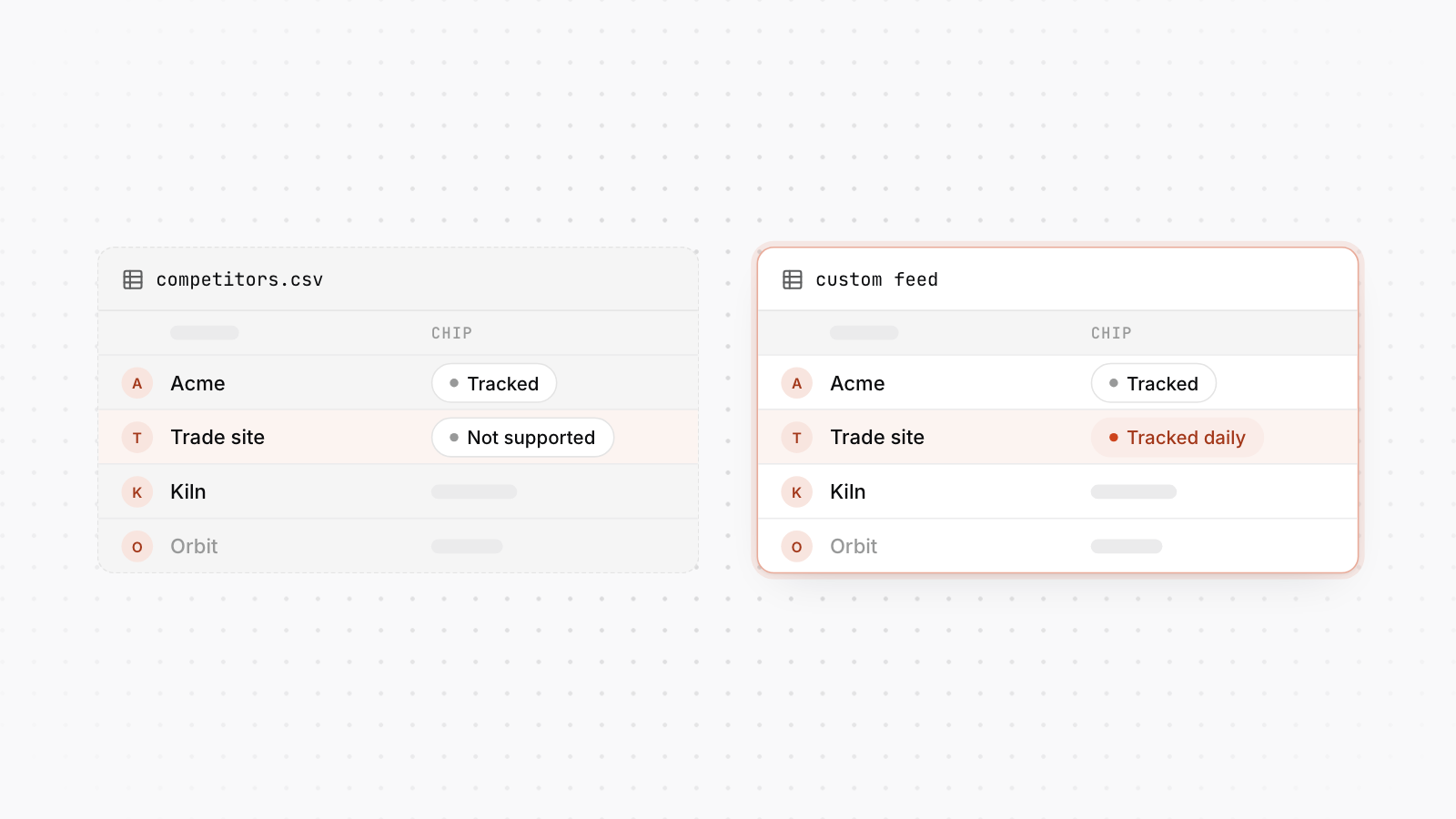
The vendor deals with site changes and anti-bot measures, which is most of the work. The weak points are coverage and fit. If a competitor is a small trade supplier, a regional chain or a B2B portal, the tool may not support it. If you need the data in your own database, check what the API costs and how often it refreshes.
A scraping API
A scraping API such as ScrapingBee fetches pages for you through rotating proxies and a real browser. Your developer writes the code that finds the price on each page, stores it and matches it to your products. ScrapingBee's self-serve plans run from $19 to $599 a month, charged in credits per request. The developer time costs far more than the requests.
This suits a business that already has a developer with spare time, and someone has to own the scraper. When a competitor redesigns a product page, the scraper may keep returning successful responses with no price in them. Unless someone built checks for that, nobody notices until the numbers look odd.
A custom scraper, built and run for you
A supplier builds scrapers for the sites you name, matches the results to your catalogue and delivers the data to your database, a spreadsheet or an API. A good contract covers monitoring and fixes when sites change, so the feed keeps working after the build. It costs more per site than a subscription, but it can reach sites the tools do not support and follow matching rules they do not offer.
When a subscription tool is the better choice
A subscription tool is the better choice when you track up to a few thousand products, your competitors are large retailers or marketplaces the tool already supports, and you are happy to read the data in the tool's dashboard. At that size and coverage, a monthly subscription costs less than any custom build, and the vendor does the upkeep.
If you sell a few hundred products and your competitors are Amazon, Argos, Currys or John Lewis, start with a subscription. Most tools offer a free trial, so test the product matching on your own catalogue before you commit. A price matched to the wrong product is worse than no price, so check matching before you worry about how many checks a day you get.
Before you buy, ask each vendor:
- Which of your competitor sites does it support today?
- How often does it check prices, and on which plan?
- How does it match your products, and how do you correct a wrong match?
- Is the API included, or charged extra?
- Does the price rise per product, per URL or per competitor?
When a custom scraper is worth paying for
A custom scraper is worth paying for when the tools do not cover your sites, your prices or the way you need the data delivered. These are the cases we see most.
Sites the tools do not support
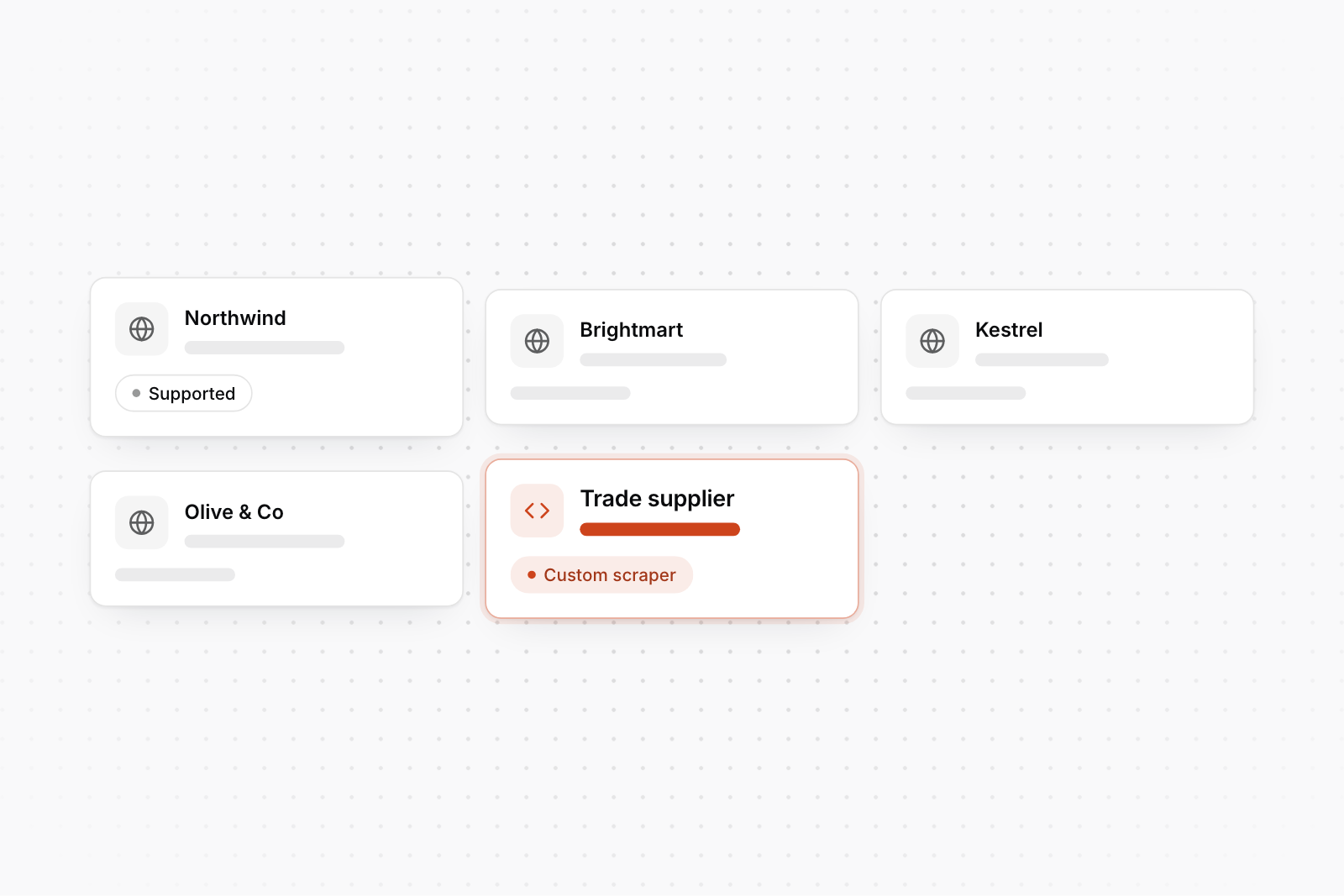
Specialist retailers, trade counters, regional chains and smaller marketplaces are often missing from subscription tools. If two or three of your most important competitors are among them, a subscription misses the prices you most want.
Trade and B2B prices
B2B prices are often quoted per customer or only shown after login. Subscription tools are built mainly for public consumer prices. We only collect what is publicly visible, so a custom scraper helps with trade prices that are published openly, such as list prices and quantity breaks. It does not help with prices behind a customer login.
Unusual matching rules
Matching by barcode or manufacturer part number is straightforward. Matching bundles, pack sizes, own-brand equivalents or products with several variants is harder. A custom build can apply your rules, for example comparing price per kilo or treating a three-pack as three units.
Data that has to feed your own systems
If the prices need to go into your own database, a repricing script, a BI tool or your ecommerce platform on a fixed schedule, a feed built for that is often simpler than exporting from a dashboard. You decide the fields, the refresh rate and the format.
Who can build a web scraper to track competitor prices
A freelance developer, a specialist scraping agency, a data provider or a development company like ours can build a web scraper to track competitor prices. Ask each one who fixes it when a site changes, and how quickly.
A freelancer can build a working scraper for a few sites. Check who maintains it afterwards and what happens if they are unavailable. Web scraping services in the UK, from scraping agencies to data providers, usually sell a managed feed, priced per site or per volume. A development company builds the scraper and the pipeline around it, and may connect the data to your other systems.
Whoever you choose, ask for these in writing:
- The list of sites, the fields collected and how often each site is checked.
- How a broken scraper is detected, including one that returns rows with no prices.
- How fast a fix happens, and whether it is included in the monthly fee.
- Where the data is delivered, and whether you keep it if you stop.
- What the supplier will not do, such as logging in or getting around blocks.
How AppBespoke builds and runs price scrapers
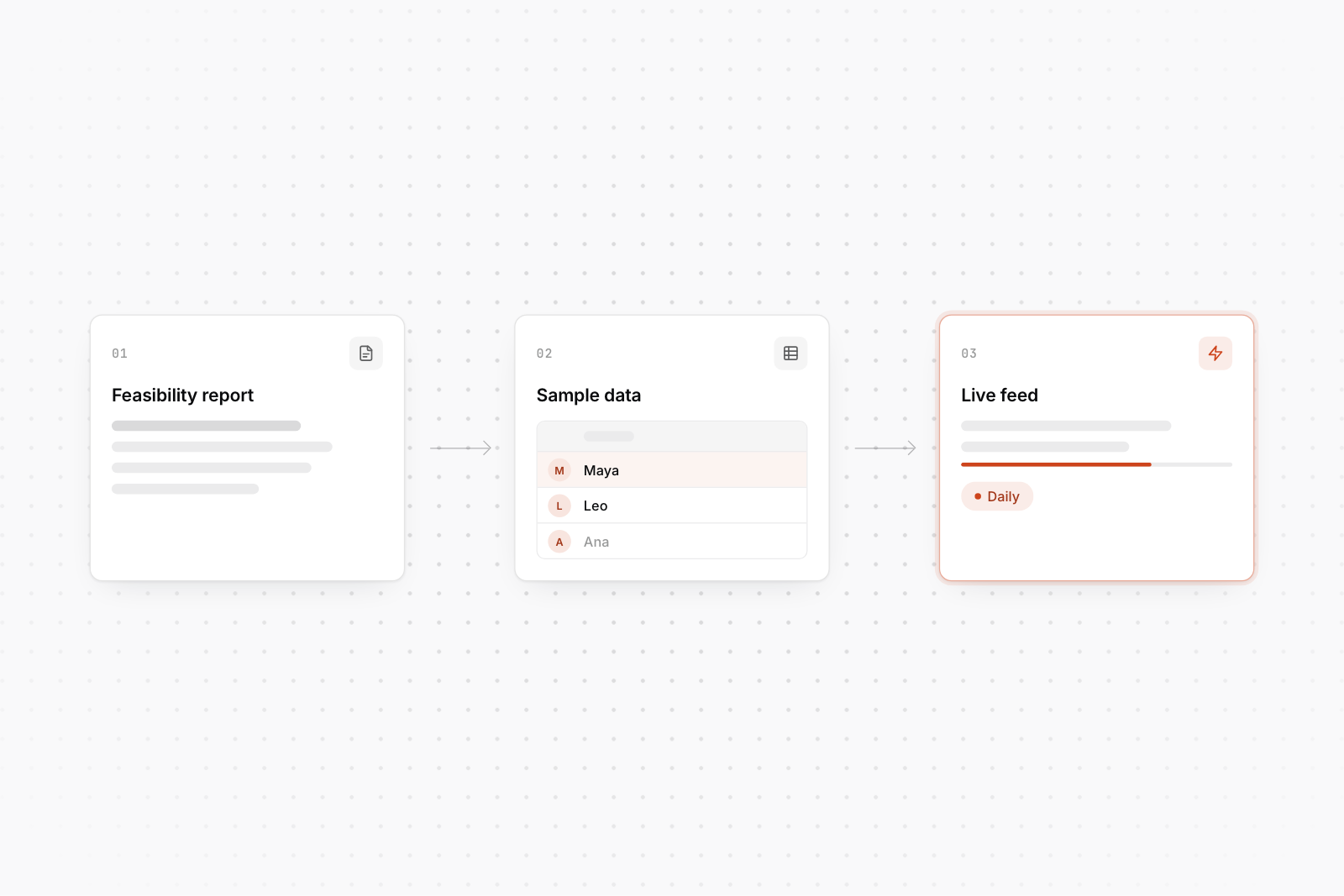
We build and run scrapers as a fixed-price service: a free written feasibility report first, then a setup fee and a monthly fee that covers hosting, monitoring and fixes when sites change. Our web scraping service page has the full detail.
What it costs
For UK customers, a Pipeline covering one source costs £2,000 to set up and then £400 a month. Pipeline plus Intelligence covers up to five sources, with change detection, alerts and push delivery to Slack, Sheets or a webhook, for £4,000 to set up and then £1,000 a month. Higher volumes, more sources or a written SLA start from £8,000, quoted after a scoping call. A source is usually one competitor site.
How it runs
You send the sites and the fields. Within two business days you get a written feasibility report that says what can be collected, what cannot and what it costs. A single-source pipeline is normally live one to two weeks after you approve the sample data. The data lands in your own database or behind an API you can query. Every pipeline is monitored for structural change as well as outright failure, so a site that starts returning half the rows raises an alert.
When we are not the right fit
We are not the right choice if you track a few hundred products on large retailers a subscription tool already supports. A subscription will be cheaper, and we will say so. We are also not right if you need a one-off dataset rather than a regular feed, if the prices you want sit behind a login or paywall, or if you want a repricing engine with its own interface. We collect public business and market data only, with no personal data.
Is web scraping legal in the UK for price monitoring?
Collecting publicly displayed prices for price monitoring is generally treated as low risk in the UK. No single law covers scraping, several areas of law apply at once, and the risk rises if you copy content, collect personal data or get around access controls. This checklist is a summary, not legal advice. Take advice from a solicitor on your own case.
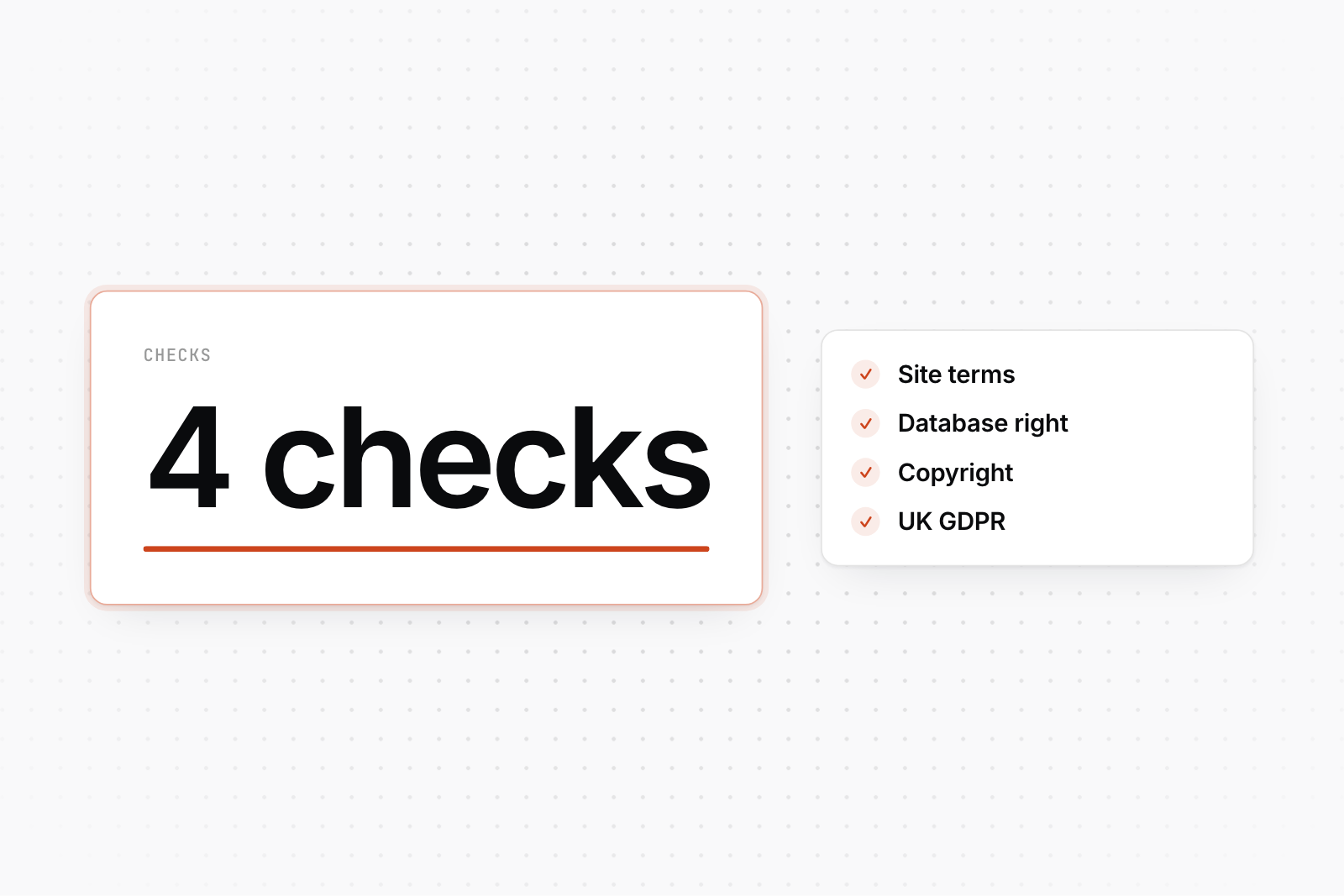
- Site terms. Many retailers' terms forbid automated access. Breaching them is a contract matter rather than a crime, but it can still lead to a claim or a blocked IP. Read the terms of each site you plan to scrape, and respect robots.txt and sensible request rates.
- Database right. The UK keeps a database right for collections that took substantial investment to build. Taking a few prices from many sites carries less risk than copying a substantial part of one retailer's catalogue.
- Copyright. A price is a fact. Product descriptions, photos and reviews can be protected by copyright. Collect the facts you need, such as price, stock status and product code, and do not republish the text or images.
- UK GDPR. Prices are not personal data, but marketplace seller names, reviewer names and contact details can be. If a scrape picks up anything about identifiable people, UK GDPR applies even when the data is public. The simplest answer is not to collect it.
Also, do not log in or get around blocks to reach data that is not public, as that moves the risk towards the Computer Misuse Act 1990. And keep request rates low enough that your scraper does not affect the site.
Next step
If you are deciding how to track competitor prices, book a 30-minute video call with us. Tell us your catalogue size and the sites you watch, and we will tell you whether a subscription tool, a scraping API or a custom scraper fits. If a custom build or a wider data project, such as extracting data from supplier invoices and PDFs, is right, the next step is our £750 technical planning day.
FAQ
FAQs
Should I use a price monitoring tool or build my own scraper?
Use a monitoring tool if your competitors are large retailers the tool supports and you track up to a few thousand products. Build or commission a scraper if key competitors are not supported, if you need trade prices that are published openly, or if the data has to feed your own systems. Many businesses start with a subscription and add a custom feed for the two or three sites it misses.
What does it cost to maintain an in-house price scraper?
The running costs are proxies or a scraping API, hosting and storage, which are usually modest. The larger cost is developer time to fix scrapers when sites change and to check the data is still correct. If nobody owns that work, the scraper will break quietly. A managed service includes that upkeep in a fixed monthly fee.
Can I track competitor prices with a Python script and a scraping API?
Yes. A developer can collect prices from a few sites with a short script and a scraping API, and that is a reasonable way to test the idea. The work grows once you add matching products to your catalogue, scheduling, storing history and alerting when a scraper stops finding prices.
How often should competitor prices be checked?
Daily suits most retailers. Several times a day suits fast-moving categories such as electronics or marketplaces where prices change by the hour. Subscription tools set the frequency by plan. With a custom scraper you set it, and more frequent checks cost more in proxies and requests.
Is web scraping legal in the UK for price monitoring?
Collecting public prices for monitoring is generally low risk, but site terms, database right, copyright and UK GDPR all apply, and getting around logins or blocks raises the risk. Collect only the factual fields you need, do not republish content, and avoid personal data. This is not legal advice.